
Kids' Closet Features That Make Morning Routines So Much Smoother
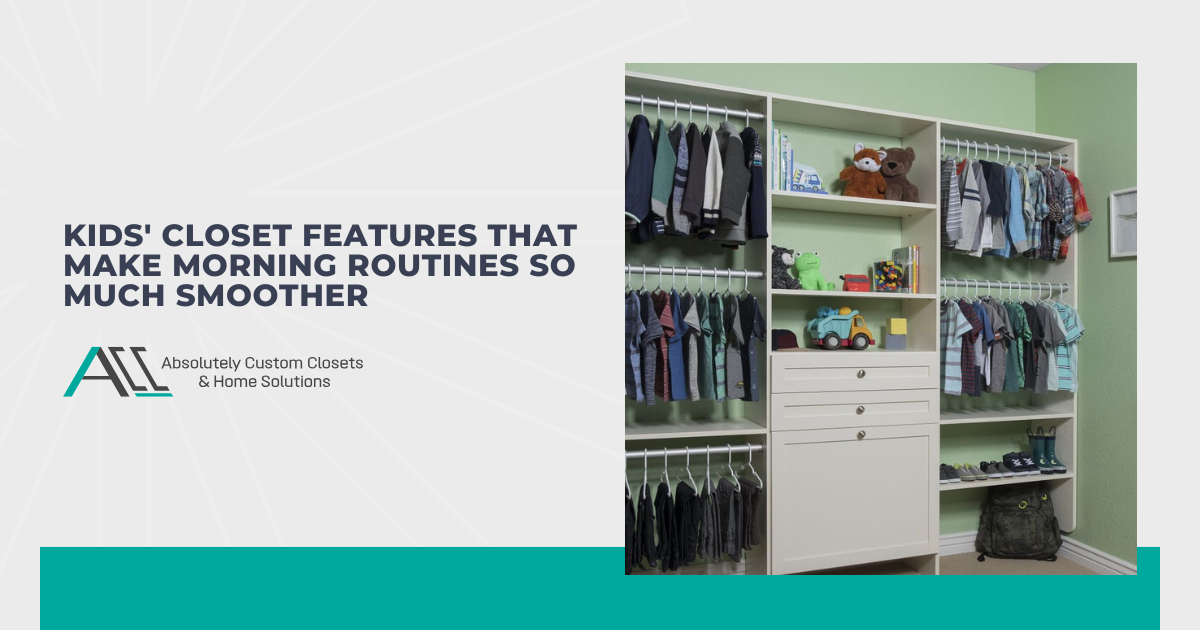
School mornings have a way of going sideways fast, and kids' closets are often the first place the chaos starts. A missing shoe, a forgotten jacket, or clothes piled on the floor instead of hung up can turn a calm morning into a stressful one. The closet is rarely the first thing parents think to fix, but it's one of the most impactful. A few thoughtful features can make a real difference in how smoothly your mornings go.
I've worked with many families on designing closets that actually work for kids, and the biggest pattern I see is that the right setup encourages independence. When everything has a clear, accessible place, kids don't need to ask for help finding things. They can grab what they need, get dressed, and be ready without the usual back-and-forth. In the right setup, even the closet becomes a quiet anchor for the whole morning routine.
These are the specific kids' closet features that can transform your mornings:
- Adjustable shelving and hanging rods
- Designated outfit planning sections
- Shoe organization that's easy to see and access
- Double hanging rods for maximized clothing access
- Built-in drawer systems for folded items
- Label-friendly storage bins and cubbies
- Lighting inside the closet
- A dedicated hook rail for next-day essentials
Read on to see which features might be the missing piece in your child's closet setup.
Adjustable Shelving and Hanging Rods
Most standard closets are built with adults in mind, which means the rods and shelves are placed at heights that are completely out of reach for young children. When kids can't reach their own clothes, they either skip the process entirely or wait for you to help them. Neither option makes mornings any easier, and the bottleneck almost always traces back to a closet that wasn't designed with them in mind.
Adjustable rods and shelving change this dynamic. You can position the hanging rod at a height your child can actually reach, so getting dressed becomes something they can manage on their own. The shelves work the same way, giving you the flexibility to reconfigure the layout as your child's storage needs shift with age.
I always recommend adjustable systems to families with young children because kids grow faster than most parents expect. A closet configuration that works well for a five-year-old won't serve a ten-year-old the same way. With an adjustable setup, you simply raise the rod and rearrange the shelves as needed, so the closet keeps working without requiring a full redesign every few years.
Designated Outfit Planning Sections
One of the biggest time drains on school mornings isn't getting dressed. It's deciding what to wear. When kids have to sort through a full closet every morning to put together an outfit, it adds unnecessary friction to an already rushed routine. A dedicated outfit planning section takes that daily decision off the table entirely.
This can look different depending on your closet layout. A pull-out valet rod is a popular option that lets you hang a full outfit, top to bottom, the night before. Cubbies or a small row of hooks work just as well for folding or draping pieces in a designated spot. The key is having a section of the closet that's clearly set apart for pre-planned outfits rather than general storage.
Many families use Sunday evenings to plan out the whole week. With the right closet setup, kids can actually take part in that process, picking out their outfits and hanging them in order. By Monday morning, there's no debate, no last-minute searching, and no stress. Your child just grabs what's already waiting for them and gets moving.
Shoe Organization That's Easy to See and Access
Shoes might be the single most chaotic element in a kids' closet. They get kicked off in random spots, buried under clothes, or separated from their pairs in ways that seem impossible to explain. On a busy school morning, searching for a matching set can eat up more time than the rest of getting ready combined.
The fix is storage that keeps shoes visible and within reach. Angled shoe shelves are a great option because they display each pair face-out, making it easy to spot exactly what you're looking for at a glance. Open cubbies work similarly, giving each pair its own designated slot at a height kids can access without help. Pull-out shoe drawers are another practical choice, especially for smaller closet spaces where wall-mounted shelves aren't an option.
The common thread across all of these solutions is accessibility. When shoes are stored at kid-level and organized so every pair is easy to see, your child can find what they need and get out the door without turning the closet upside down first. It's a small shift in storage strategy, but it removes one of the most consistent morning holdups.
Double Hanging Rods for Maximized Clothing Access
A single long hanging rod is the default in most closets, but it's one of the least efficient setups for kids' clothing. In my experience, that one rod ends up crowded quickly, with everything crammed together and harder to sort through than it needs to be. It also leaves a significant amount of vertical space completely unused below the hanging clothes.
Stacking two shorter rods solves both problems at once. The upper rod can hold jackets, uniforms, or anything that needs a bit more length, while the lower rod keeps everyday tops, shorts, and pants at a height your child can reach independently. Everything stays separated by category, which makes getting dressed faster and putting clothes away easier.
This setup also makes the closet feel more organized at a glance. When your child can see every item hanging at their eye level, they're not pushing things aside or pulling half the closet down just to find one shirt. A double rod system is a simple structural change that quietly improves how the whole closet functions day to day.
Built-In Drawer Systems for Folded Items
Most kids split their mornings between two places: the closet and the dresser. Socks in one room, shirts in another, underwear somewhere in between. This back-and-forth adds up quickly, and it also gives kids more opportunities to get distracted before they're fully dressed and ready to go.
Built-in drawers inside the closet consolidate everything into one spot. Socks, underwear, folded shirts, and pajamas can all live within the same space as hanging clothes, so your child doesn't need to leave the closet until they're completely dressed. It simplifies the morning routine by turning what used to be a multi-stop process into a single, contained one.
Drawer dividers make the system even more effective. When each section of a drawer is designated for a specific item, kids know exactly where to look and where to put things back. This consistency is what keeps the closet organized past the first week. A drawer system that's easy to maintain is one your child will actually use correctly, and that makes a noticeable difference on rushed mornings.
Label-Friendly Storage Bins and Cubbies
Storage bins and cubbies are only as useful as the system behind them. Without clear labels, they quickly become catch-all spots where things get tossed in without much thought. A bin labeled "art supplies" stays organized. An unlabeled bin becomes a mystery drawer that nobody wants to sort through.
For younger kids, picture labels are especially effective: a photo of socks on the sock bin or a drawing of a hat on the accessories cubby. At that age, reading isn't always reliable, but recognizing an image is. As kids get older, text labels work just as well and give them a clearer sense of ownership over their space.
The real value of a labeled system isn't just finding things in the morning. It's making sure things get put back in the right place after laundry day or after a weekend of pulling everything out. When your child knows exactly where each item belongs, tidying up becomes just as straightforward as getting dressed. A closet that stays organized between uses is one that actually supports the morning routine all week long.
Lighting Inside the Closet
A dark closet slows everything down. Your child ends up squinting at tags, grabbing the wrong color, or just picking whatever's easiest to see rather than what they actually want to wear. It's a small inconvenience that adds up quickly on mornings when every minute counts. And on the mornings when you're already running late, that extra delay is the last thing you need.
Good closet lighting doesn't have to be complicated. LED strip lights along the top shelf are a popular and affordable option that brighten the entire space evenly. Motion-activated fixtures are another practical choice, turning on automatically the moment your child opens the closet door and eliminating the need to fumble for a switch. For walk-in closets, a centrally placed overhead light makes a significant difference in how easy it is to navigate the space.
Proper lighting also helps kids make faster, more confident choices. When your child can clearly see every item in the closet, there's less second-guessing and less time spent standing in front of an open closet door. It's one of those features that tends to get overlooked during a closet design, but once it's in place, the difference is hard to miss.
A Dedicated Hook Rail for Next-Day Essentials
Backpacks, sports bags, jackets, and scarves rarely make it back into the closet at the end of the day. They end up on the floor, draped over a chair, or dropped somewhere near the front door. Come morning, finding all of it becomes a frantic last-minute scramble that delays everyone, not just your child.
A built-in hook rail inside the closet gives those items a home that's easy to use consistently. I often describe it to families as a "launch pad" for the next morning: Everything your child needs to walk out the door hangs in one visible spot, ready to grab on the way out. It takes seconds to use the night before, and it eliminates the morning search entirely.
Keeping school gear inside the closet also has a practical benefit for the rest of your home. Entryways and bedrooms stay cleaner when bags and jackets aren't piling up in random spots. And because the hook rail is part of the closet rather than an afterthought, it becomes a natural part of your child's end-of-day routine rather than an extra step they're likely to skip.
Conclusion
Mornings with kids will never be completely predictable, but the right kids' closet setup removes a lot of the variables that make them harder than they need to be. When your child can find everything on their own and head out the door with everything they need, you get your mornings back too. The right features, thoughtfully put together, can turn one of the most stressful parts of the day into something your whole family barely has to think about.

QUICK LINKS
CONTACT INFO
Absolutely Custom Closets & Home Solutions LLC
7131 West Akron-Canfield Road Suite C, Canfield, OH 44406
Phone
SCHEDULE A CONSULTATION
Contact us, and we will come out and discuss your project free of charge.